Yes, you can learn Arabic online from the UK—and you don’t need to move to Cairo or find a local class that fits your schedule. Thousands of UK-based learners are studying with native Egyptian teachers right now, from London flats, Edinburgh homes, and everywhere in between. This guide covers everything: why online works, how to start, which methods actually move the needle, and what to do when motivation dries up.
Why are we talking about studying Arabic in Britain even though we operate online? Because many of our students from Britain come to study with us and tell us that the schools and teachers there force them to study for very long periods, but unfortunately, they don’t see results. Of course, they get bored and waste their time commuting and facing other problems and challenges. Therefore, we decided to guide you and let you know that you are not alone in this problem. We are here to help you and tell you that your situation matters to us.
Why Learn Arabic Online from the UK?
Honestly, the UK is one of the best places in the world to start learning Arabic online. Not because of geography—but because of demand, community, and access.
Arabic is the fifth most spoken language on earth, with over 400 million native speakers. And in the UK specifically, it’s spoken by large communities across London, Manchester, Birmingham, Edinburgh, and beyond. That means language exchange partners are closer than you think, Arabic media is accessible, and the motivation is real—career, heritage, faith, or curiosity.
But the real game-changer? Online learning means your teacher doesn’t have to be in your postcode.
The UK Arabic Learning Landscape
Traditional routes for learning Arabic in the UK involved commuting to a college in central London or hoping your city had a community class that didn’t conflict with your schedule. Cities like Edinburgh had limited options. East London had more, but still restricted to fixed times.
Now? A certified Al-Azhar-trained teacher in Cairo can be in your living room (via Zoom) at 6am before work, or 10pm after the kids are in bed. No commute. No fixed class schedule. Lessons starting from $40.
That flexibility is the whole point—and it changes who can realistically learn Arabic.
Who Is This For?
This is for you if:
- You want to learn Arabic but can’t commit to fixed weekly class times
- You’re in the UK and need a native-speaker teacher without local availability
- You’re motivated by faith (Quran, Islamic studies), career (Middle East business, NGO work, journalism), or heritage
- You’re a complete beginner or returning to Arabic after a long gap
- You want GCSE Arabic support for your child
This is NOT for you if:
- You’re looking for a fully free solution (quality teaching costs something)
- You want to learn a specific dialect only and aren’t open to MSA as a foundation
- You expect fluency in 3 months without consistent daily practice
Getting Started: Assess Your Level First
Before picking a course or booking a teacher, you need an honest picture of where you’re starting from. Most people either underestimate or overestimate themselves, and both cause problems.
Overestimating leads to frustration when material is too hard. Underestimating means boring yourself through content you already know.
The fastest way to find your level? Take a proper placement test. Alphabet Arabic Academy offers a free Arabic level test that places you accurately in under 15 minutes. Use it before you do anything else.
If you’d rather self-assess first:
Can you read Arabic script at all? If no, you’re a true beginner—and that’s completely fine. The alphabet takes 2–4 weeks to learn properly with daily practice.
Can you read but not understand? That’s A1–A2 level. You can decode words but lack vocabulary and grammar.
Can you hold a basic conversation? You’re likely B1, and should skip beginner courses entirely.
Don’t guess. Test. It saves months of wasted time.
Choosing the Right Course for Your Goal
Once you know your level, the next decision is: what kind of Arabic do you actually need?
This matters more than most learners realise.
Modern Standard Arabic (MSA/Fusha): Best for reading news, studying literature, understanding the Quran, and professional contexts across the Arab world. The right starting point for most UK learners. Alphabet Arabic Academy’s MSA course covers this systematically from beginner to advanced.
Egyptian Colloquial Arabic: The most widely understood dialect. Great if you want conversational skills fast or plan to spend time in Egypt. Also serves as a stepping stone to other dialects.
Quranic Arabic: Focused on understanding the Quran’s language—vocabulary, grammar, and tajweed rules. A distinct track from conversational Arabic.
Professional Arabic: Business vocabulary, formal writing, media Arabic. Relevant for careers in diplomacy, journalism, finance, or NGO work across the MENA region.
If you’re unsure, start with MSA. It gives you the strongest foundation and transfers to every other track.
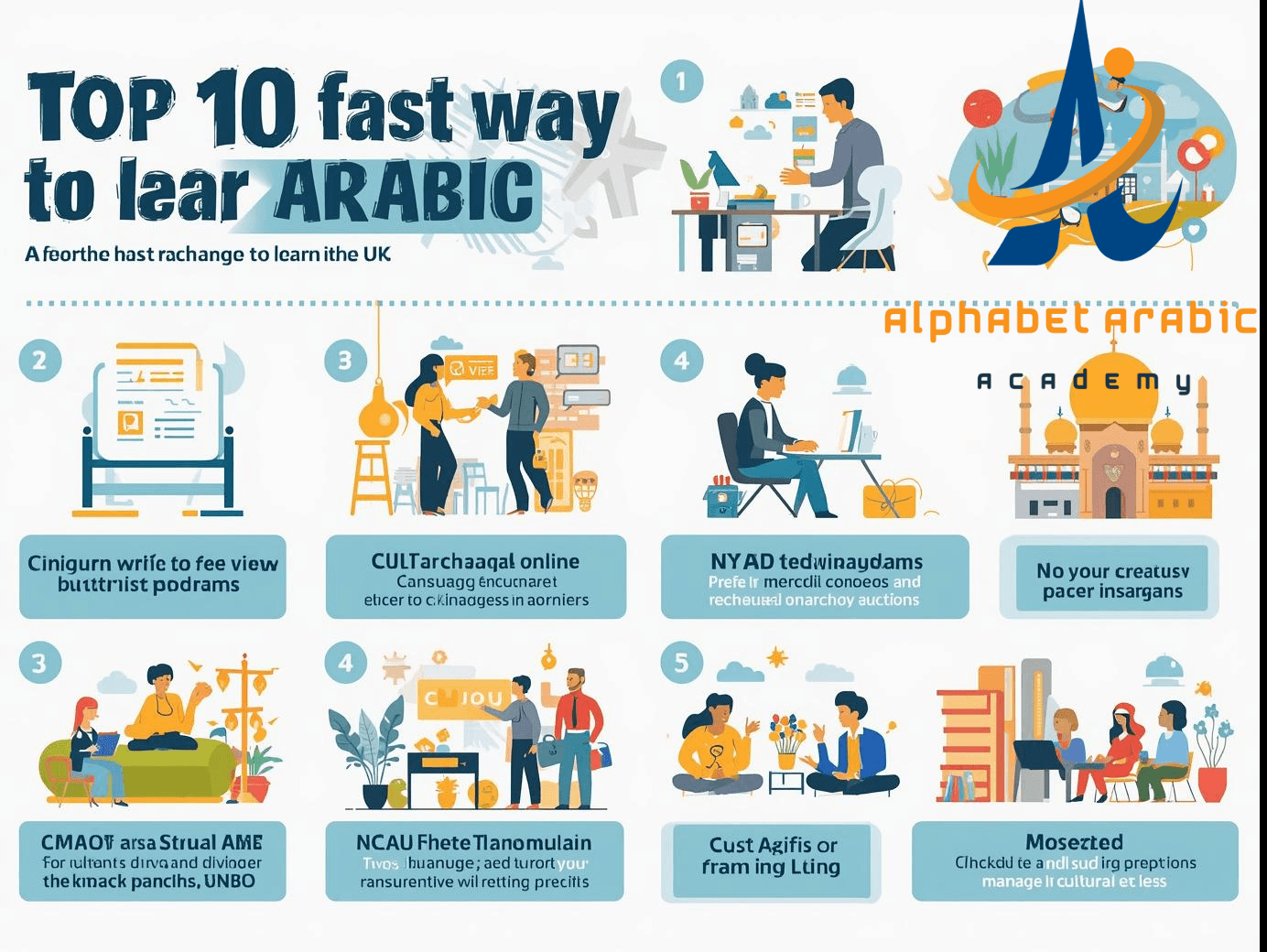
Top 10 Ways to Learn Arabic in the UK: Faster and Easier

Here’s the honest truth: there’s no single method that works for everyone. What works is combining the right methods for your learning style, schedule, and goals. These ten approaches are what actually move learners forward—not just keep them busy.
1. Live 1-on-1 Online Classes with a Native Teacher
This is the highest-leverage thing you can do. Not the cheapest, but the most effective per hour. A qualified teacher from Alphabet Arabic Academy’s teaching team gives you instant pronunciation correction, personalised progression, and the accountability of a real person expecting you to show up.
Even one session per week changes the quality of your self-study dramatically.
2. Structured Textbook Study (Al-Kitaab, Al-Arabiya Bayna Yadayk)
A good textbook gives you a spine. Without one, self-study feels aimless. Al-Arabiya Bayna Yadayk is the textbook used by Alphabet Arabic Academy—comprehensive, well-structured, and designed for non-native learners.
Pair it with audio and exercises. Don’t just read—write, speak, and listen.
3. Spaced Repetition Flashcards (Anki)
Vocabulary is the unglamorous foundation. You need it. Lots of it. And spaced repetition—reviewing a word just before you’d forget it—is the most efficient way to build it.
Anki is free and powerful. Start with the most common 500 Arabic words. Add 10–20 new cards daily. Review every single day, even when it’s just 7 minutes.
By month six, you’ll have a working vocabulary of 800–1,200 words—enough to start reading simple Arabic texts.
4. Arabic Podcasts and Audio Lessons
For UK learners with commutes, this is gold. ArabicPod101 has content at every level. Download episodes. Listen on the Tube, in the car, on a walk. Hands-free language learning that fits British life perfectly.
Pro tip: listen to the same episode three times. First for general meaning, second for vocabulary, third for pronunciation patterns.
5. Arabic Media (Shows, News, YouTube)
Al Jazeera English, Egyptian drama series, Arabic YouTube channels—authentic input that trains your ear and builds cultural context simultaneously.
For beginners: start with content you already know in Arabic dubbing (familiar story, new language). For intermediate learners: Egyptian dramas work well—the pacing is slower than news, and Egyptian Arabic is the most widely understood dialect.
6. Language Exchange Apps (Tandem, HelloTalk)
Free speaking practice with native Arabic speakers who want to learn English. You spend 30 minutes on your Arabic, 30 minutes helping them. Real conversation, no cost.
Be specific in your profile: “A2 level, want to practise describing daily routines, prefer patient speakers.” You’ll find better partners faster.
7. Mobile Apps for Daily Habit Building
Duolingo, Memrise, and similar apps are perfect for the days when life is chaotic and 10 minutes is all you’ve got. They’re not sufficient alone—but they keep momentum alive between proper study sessions.
Use them for the gaps. Not as your primary curriculum.
8. Arabic Grammar Workbooks
Grammar is unavoidable in Arabic. The dual form, verb conjugation patterns, broken plurals—these need deliberate practice. A good grammar workbook (Mastering Arabic Grammar, Routledge Modern Standard Arabic) gives you targeted exercises that build accuracy.
Even 15 minutes of grammar work daily compounds quickly.
9. Arabic Writing Practice
Writing slows your thinking down in the best way. It forces you to recall vocabulary and grammar simultaneously. Write three sentences in Arabic every day. Describe something in your environment. Summarise what you learned in your last lesson.
It feels small. It compounds fast.
10. Monthly Tutor Check-ins for Corrections
You can’t hear your own accent problems. You can’t always catch your own grammar errors. A monthly 30–60 minute session with a qualified teacher isn’t a full course—it’s calibration. Show what you’ve learned, get corrections, ask your accumulated questions.
This hybrid approach—primarily self-study plus monthly teacher sessions—is the most cost-effective path to real proficiency for UK learners. See all Arabic course options and pricing.
Arabic Lessons in London, Edinburgh, and Beyond: Online vs. In-Person
A lot of UK learners start by searching for local classes—Arabic lessons in London, classes in Edinburgh, east London Arabic courses. And those options exist. But they come with real constraints.
The In-Person Reality
Physical Arabic classes in the UK are available in select cities. London has options through institutions like City Lit in Covent Garden and the Arab-British Centre. Edinburgh has some provision. Manchester, Birmingham, and other cities have community offerings.
But here’s what you’ll typically find:
- Fixed schedules (Tuesday evenings, weekend mornings)
- Group progression—the class moves forward whether you’re ready or not
- Limited teacher options (you get whoever’s available locally)
- Higher cost per hour for classroom-based delivery
- No makeup classes if you miss one
For many UK learners—especially those with demanding jobs, children, or unpredictable schedules—these constraints make in-person classes impractical long-term.
Why Online Arabic Classes Win for UK Learners
The advantages aren’t subtle.
Any time zone, any schedule: Alphabet Arabic Academy teachers are available 24/7. Early morning before work. Late evening after the kids are asleep. Weekend afternoons. You choose.
Native Egyptian teachers, Al-Azhar certified: The quality of teacher access online exceeds what most UK cities can offer locally. Every Alphabet Arabic Academy teacher holds a university degree in Arabic language or Islamic studies.
One-to-one, not group: No holding back for slower learners. No feeling left behind when you struggle with a concept. The lesson is entirely about you.
Cost: Starting from $40 per session, with all materials included. No travel costs. No missed class fees.
Continuity: Moving from London to Edinburgh? Travelling for work? Your teacher is always just a Zoom link away.
The honest verdict: for UK learners in 2025, online Arabic classes are the superior option for the vast majority of people. In-person works if you specifically value physical classroom community. Otherwise, online wins on every practical dimension.
Arabic Language Skills: The 10 Building Blocks

Understanding what you’re actually developing helps you study smarter. Arabic proficiency isn’t one thing—it’s ten overlapping skills that build on each other.
1. Alphabet Recognition
Reading Arabic script. Takes 2–4 weeks with daily practice. Non-negotiable foundation.
2. Phonetics and Pronunciation
Arabic has sounds that don’t exist in English—the ع (ayn), the خ (kha), throat sounds. Getting these right early prevents fossilised errors later.
3. Vocabulary
Words are the content of communication. Target the most frequent 1,000 words first. They cover roughly 85% of everyday conversation.
4. Grammar (Nahw)
Arabic grammar is systematic and logical. Noun gender, verb patterns, case endings. Challenging but learnable—especially with a good teacher.
5. Reading Comprehension
Moving from decoding letters to understanding meaning. Graded readers bridge the gap between textbook Arabic and real texts.
6. Listening Comprehension
Understanding spoken Arabic at natural speed. This lags behind reading for most learners and requires specific ear-training practice.
7. Speaking
Production skills—putting words together in real-time conversation. Improves fastest with consistent speaking practice, not just listening.
8. Writing
Composing in Arabic—from simple sentences to paragraphs to formal texts. Underrated skill that dramatically strengthens grammar accuracy.
9. Cultural Competence
Understanding the context behind the language: how Arab speakers communicate, what’s polite, what’s direct, how formality shifts between dialects and MSA.
10. Quranic/Classical Arabic (where relevant)
For learners motivated by faith, this is a distinct track—classical vocabulary, tajweed rules, and understanding text that’s 1,400 years old. It overlaps significantly with MSA but has unique elements.
For a comprehensive dive into all four skills and Arabic grammar, see the full Arabic course online guide.
Structuring Your Study Routine as a UK Learner
British life is busy. Full stop. The study routine that works has to be honest about that.
The best routine isn’t the most intense one—it’s the most consistent one. Here’s how to build it.
Daily Minimums (Non-Negotiable)
Absolute minimum on terrible days: 10 minutes. Open Anki, review your flashcards. That’s it. The chain stays alive.
Standard day: 25–30 minutes. 10 minutes Anki, 15 minutes lesson or reading, 5 minutes writing three sentences.
Good day: 45–60 minutes. Full lesson unit, listening practice, maybe a language exchange call.
The mental shift: stop thinking about “studying Arabic” as a discrete task you either do or skip. Think of it as a daily habit, like brushing your teeth. It happens. Every day. Some days longer, some days shorter, but it happens.
UK-Specific Time Slots That Work
Morning commute (tube, train, bus): Arabic podcasts, audio lessons, Anki reviews. Completely passive on a packed Tube—or active on a quieter train.
Lunch break: 15–20 minutes of focused lesson work. A full unit, some grammar exercises, or writing practice.
Evening (after kids’ bedtime or after work): Longer sessions. Live teacher calls work well here because Cairo is 2 hours ahead—evening UK time is prime time in Egypt.
Weekend mornings: Longer immersive sessions. Watch a 45-minute Arabic drama episode. Do a proper grammar study session.
Setting Realistic UK Milestones
Here’s what’s achievable for a UK learner averaging 25–35 minutes daily:
Month 1–3: Arabic alphabet mastered, 400+ words, basic introduction sentences, numbers and greetings.
Month 4–8: Elementary grammar, 1,200+ words, reading simple texts, understanding basic audio.
Month 9–15: Intermediate, 2,500+ words, reading news headlines, understanding 40–60% of Al Jazeera.
Month 18+: Functional proficiency. Professional email writing, sustained conversation, Quran comprehension (if that’s your goal).
These assume consistency—not perfection. Holidays, work pressure, family demands will interrupt you. That’s fine. The timeline stretches, not ends.
Improving with an Arabic Teacher Online: What to Expect

Working with an online Arabic teacher changes the learning trajectory significantly. But many UK learners don’t know what to expect from their first sessions, or how to make the most of them.
What Good Online Arabic Teaching Looks Like
Your teacher should be doing more than just explaining grammar. Look for:
Immediate pronunciation correction. Not at the end of the lesson—in the moment. Good Arabic teachers catch phonetic errors immediately, before they become habits.
Lesson customisation. Your session isn’t a repeat of someone else’s. The teacher should adapt to your level, goals, and what you covered last week.
Output focus. You should be speaking, not just listening to your teacher speak. A good session is at least 50% you.
Homework and accountability. Simple assignments—write three sentences, review these 20 words, listen to this audio. Not to overwhelm you, but to keep progress moving between sessions.
How Often Should UK Learners Book Sessions?
For beginners: twice weekly if budget allows, once weekly as a minimum.
For intermediate learners using hybrid self-study: once every two weeks is often enough, supplemented by daily independent practice.
For advanced learners: monthly check-ins to catch errors, refine pronunciation, and push into harder material.
The frequency that’s sustainable beats the frequency that’s optimal. One consistent session per week for a year produces far better results than intense daily sessions that burn you out after six weeks.
Want to see who you’d be learning with? Browse Alphabet Arabic Academy’s certified teachers—all native Egyptian speakers, Al-Azhar qualified, with an average of 15+ years experience.
Common Mistakes UK Arabic Learners Make

These aren’t obscure problems. They’re the mistakes that derail most learners. Knowing them in advance puts you ahead.
Mistake 1: Skipping the alphabet phase Some beginners try to learn Arabic through romanisation (writing Arabic words in English letters). It feels faster. It isn’t. You’ll plateau within weeks and need to go back. Spend 3–4 weeks on the alphabet properly. It’s the only foundation that works.
Mistake 2: Resource hopping Downloading five apps, buying two textbooks, watching six YouTube channels—and bouncing between them every week when progress feels slow. Pick one primary resource. Commit to it for three months minimum. Consistency with an average resource beats variety with excellent resources every time.
Mistake 3: Ignoring speaking from day one Arabic learners often read and listen for months before attempting to speak. By then, they’ve got deeply ingrained pronunciation habits they can’t hear themselves. Speak from week one, even badly. Especially badly. It’s how you improve.
Mistake 4: Equating “busy” with “can’t study” Ten minutes is not nothing. It’s your Anki reviews. It’s one audio lesson. It’s writing three sentences. The learners who succeed aren’t the ones with the most free time—they’re the ones who found the 10 minutes even on impossible days.
Mistake 5: Treating dialect and MSA as either/or Some learners argue: “I only want Egyptian Arabic, not MSA.” Others insist on formal Arabic exclusively. Both miss out. MSA gives you literacy, transferability, and a stable grammar framework. A dialect gives you natural conversation. For most UK learners, MSA as a foundation plus Egyptian dialect exposure produces the most complete Arabic speaker.
For more on building effective habits and avoiding stagnation, the best way to learn Arabic at home guide covers this in depth.
Let me tell you about zacharria
He’s a British-Pakistani from East London. He grew up hearing Arabic at home—from his parents, from the mosque, from community events. But he never learned to read or write it properly. He could speak a little. Understand a little. But formal Arabic? Quranic Arabic? Professional Arabic for his work in international development? Zero.
He tried local classes first. Evening classes at a community centre in Ilford. Fixed schedule, fixed pace, 15 other students. He lasted 8 weeks. The class moved too slowly for him. He felt like he was wasting his time and his £250.
Then he tried apps. Duolingo, Memrise, a few others. Three months of daily grinding. He learned some vocabulary. But he still couldn’t read a single paragraph fluently or write a coherent sentence.
Finally, he found us. Online. One-to-one. With a native Egyptian teacher who specialises in teaching heritage learners.
We placed him at A2 (not beginner—he knew more than he realised). Six months of consistent weekly sessions, plus daily self-study during his commute from East London to central London.
Today? He’s B1. Reading news headlines. Writing emails. Understanding Quranic Arabic in a way he never thought possible.
His wife told me recently: “I’ve never seen him this committed to anything.”
zacharria’s story isn’t unique. It’s the story of dozens of UK learners who thought Arabic wasn’t for them—until they found the right system and the right teacher.
Frequently Asked Questions
Q1: Can I really learn Arabic properly online from the UK, or do I need to be immersed in an Arab country?
You can reach genuine proficiency online—thousands of UK learners have. Immersion in an Arab country accelerates speaking and listening, but it’s not required. What matters more is consistency, quality of instruction, and regular interaction with native speakers. Online classes with native Egyptian teachers, combined with Arabic media and language exchange, can replicate much of the immersion effect without leaving home. Full immersion helps most at intermediate-to-advanced level; it’s not needed to get there.
Q2: How much does it cost to learn Arabic online in the UK?
It varies. Alphabet Arabic Academy starts at $40 per session for one-to-one lessons, with all materials included. Apps like Duolingo are free but insufficient alone. A realistic monthly budget for serious progress: $80–160 per month (two weekly sessions) or $40–60 (one session per week with daily self-study). Compare this with traditional Arabic courses in London, which can run £200–400+ per term for group classes. The online model delivers better personalisation at lower cost.
Q3: What’s the difference between Arabic classes in London and online Arabic lessons?
In-person London classes offer physical classroom community and face-to-face interaction—which some learners genuinely value. But they come with fixed schedules, group pacing, limited teacher options, and no flexibility for missed classes. Online Arabic lessons give you access to a much wider pool of qualified native teachers, flexible scheduling across any time zone, one-to-one personalisation, and often lower cost. For the majority of UK learners, particularly busy professionals and parents, online is the more practical and effective option.
Q4: How long will it take to go from beginner to conversational Arabic?
With consistent study of 25–35 minutes daily plus one weekly teacher session, most learners reach basic conversational ability within 9–12 months. Intermediate proficiency (reading news, understanding TV, professional emails) typically takes 18–24 months. Arabic is rated Category IV by the US Foreign Service Institute—meaning it takes roughly 2,200 classroom hours for English speakers to achieve professional proficiency. But “conversational” and “useful for your life” come much sooner than “fully proficient.” Set 12-month goals, not 3-month fantasies.
Q5: Should I learn Modern Standard Arabic or Egyptian dialect for the UK context?
Both serve real purposes. For career and academic purposes—diplomacy, journalism, Middle East studies, business—MSA is essential. For connecting with Arab communities across the UK, Egyptian dialect is the most universally understood colloquial variety. The best approach for UK learners: begin with MSA for your first 12 months, then add Egyptian dialect. The grammar foundation from MSA makes dialect acquisition dramatically faster. If you’re specifically in east London or Edinburgh and want community connection immediately, some Egyptian Arabic from week one alongside MSA foundation work is a perfectly reasonable approach.
Conclusion
Learning Arabic online from the UK isn’t just possible—it’s the smartest way to do it in 2025. You get access to the best native Egyptian teachers, flexible scheduling that fits British life, and a learning path you can sustain for the years it takes to reach real proficiency.
The students who succeed don’t have more time than you. They’ve got a clear goal, a consistent daily minimum (even just 10 minutes), a decent resource they stick to, and occasional human feedback to keep them calibrated.
That’s it. No magic. No shortcuts. Just consistency, with the right support.
Ready to find out exactly where you’re starting from? Take the free Arabic level test and get your personalised placement in 15 minutes.
Or, if you’re ready to book your first lesson, see full pricing and course options at Alphabet Arabic Academy pricing. Your first trial lesson is free—no credit card, no commitment.
Start today. Your future self will thank you.
بسم الله — In the name of Allah.